SKU: 41822063498
red vine succulent

red vine succulent Red Jade Vine (Mucuna Bennettii)

Sale price$25.94 Regular price$28.82
Save 10%

Pay in installments of $7.21 with ShopPay, AfterPay and Klarna

Shipping Estimate
USA
  • USA
  • CAN

Ships within 48 hours · Estimated delivery Jul 19 - Jul 24

Promo Codes Available:

For Your Every Summer RSVP, with Code: SUMMER15

Description

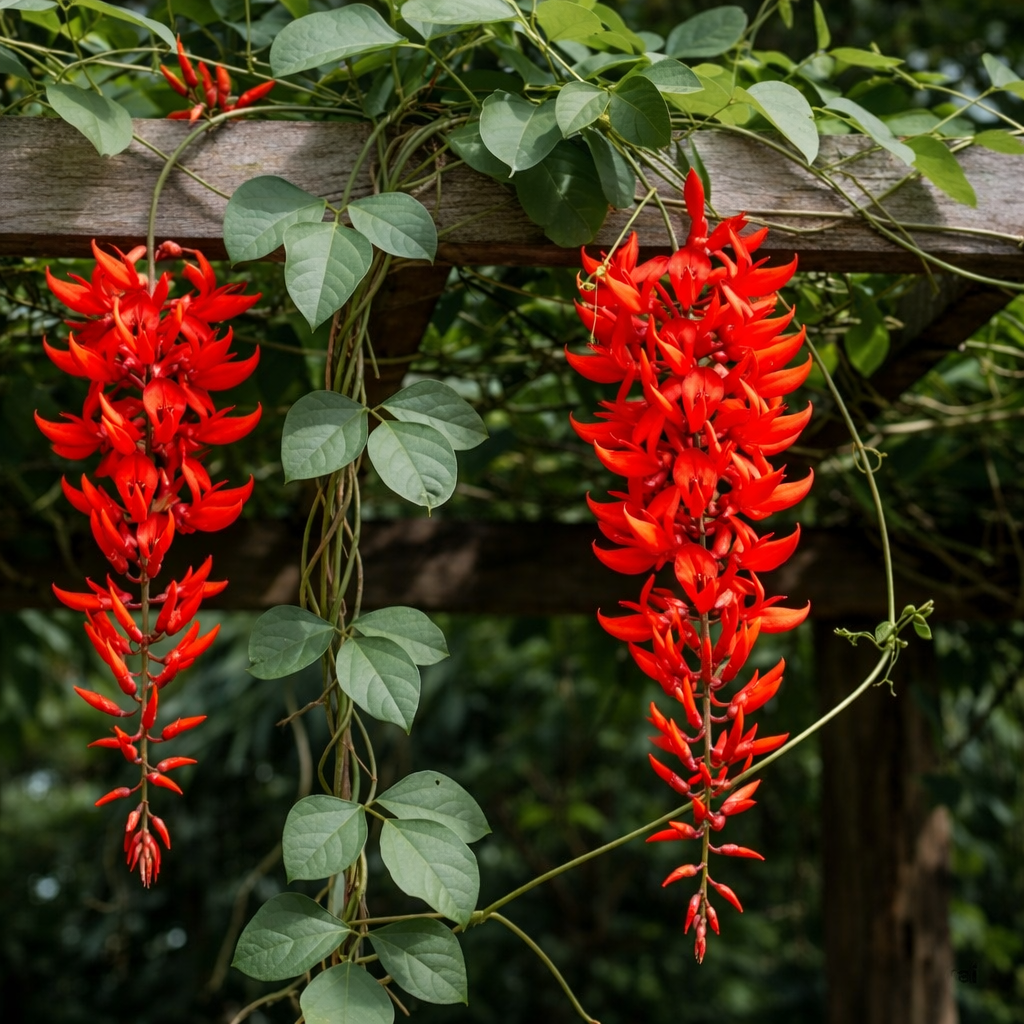
red vine succulent Red Jade Vine (Mucuna Bennettii)There are spectacular flowering vines and then there is the Red Jade Vine (Mucuna bennettii). Native to the tropical rainforests of Papua New Guinea and distributed across the islands from Sulawesi to Vanuatu, it produces pendant racemes of fiery scarlet, claw shaped flowers that hang in chandelier like clusters up to 90120 cm long each raceme a cascade of dozens of vivid blooms that drip with nectar and attract birds from a distance. It is a

There are spectacular flowering vines — and then there is the Red Jade Vine (Mucuna bennettii). Native to the tropical rainforests of Papua New Guinea and distributed across the islands from Sulawesi to Vanuatu, it produces pendant racemes of fiery scarlet, claw-shaped flowers that hang in chandelier-like clusters up to 90–120 cm long — each raceme a cascade of dozens of vivid blooms that drip with nectar and attract birds from a distance. It is a vigorous, woody climber that grows fast and reaches impressive size, requiring a strong tree, pergola, or trellis to support it. In India's tropical and subtropical climate it is completely at home outdoors year-round — and a well-established vine in full flower is genuinely one of the most dramatic sights in the plant world.

💡 The Most Important Rule — Sun on Top, Shade on the Roots Red Jade Vine has an unusual requirement that catches many growers off-guard: the canopy wants full sun, but the roots must stay cool and shaded. Plant at the base of a tree or pergola where the root zone stays naturally shaded, or mulch the root area heavily (7–10 cm deep) to keep it cool. Exposed, sun-baked roots cause chronic stress, yellowing, and failure to flower — even when the vine above looks healthy.
☀️

Light

Full sun to bright partial shade for the canopy — at least 6 hours of direct sunlight daily produces the most vigorous growth and flowering. South or west-facing open garden positions are ideal. Roots must be kept shaded at all times — see note above.

💧

Watering

Keep soil consistently moist during the growing season — water deeply 2–3 times a week in warm weather. Allow the top few centimetres to dry slightly between waterings; the vine tolerates brief dry spells but not prolonged drought. Mulch heavily to retain soil moisture and keep roots cool. Reduce watering in cooler months.

💦

Humidity

Moderate to high humidity preferred — thrives in India's tropical outdoor climate without intervention. For potted specimens in drier conditions, mist the foliage in the morning. Sensitive to cold dry air below 13°C — bring indoors or protect during cold spells.

🌱

Growing Media

Deep, rich, well-draining organic soil. Mix 35% loamy garden soil, 35% well-rotted compost or FYM, 20% coarse sand or perlite, 10% coco coir. pH 6.0–7.5. For pots, use the largest container possible — at least 45–50 cm wide and deep. Mulch the surface 7–10 cm deep. In-ground planting is strongly preferred for mature plants.

🌾

Feeding

Feed with a balanced or phosphorus-rich fertilizer (low nitrogen) every 6–8 weeks during the growing season. High nitrogen promotes excessive leaf growth at the direct expense of flowering — avoid it. Top-dress with well-rotted compost every 3 months. Stop feeding in winter.

🌸 Flowering — What to Expect and When Red Jade Vine typically flowers from its second year onwards, with blooms appearing in autumn and winter. Each raceme takes weeks to develop fully — do not disturb the vine once buds are forming. Prune immediately after flowering to encourage strong new growth for the next season's flowers. Consistent bright light, cool roots, and low-nitrogen feeding are the three most reliable triggers for flowering.
⚠️ Common Issues & Quick Fixes

Yellow Leaves

The most common symptom — almost always caused by cold temperatures below 13°C or overheated, sun-exposed roots. Check temperature and ensure the root zone is shaded and mulched. Overwatering or poor drainage can also cause yellowing — check soil conditions.

Not Flowering

Most likely causes: plant under 2 years old, roots in direct sun, too much nitrogen fertilizer, or insufficient light. Ensure roots are shaded and mulched, switch to a low-nitrogen bloom fertilizer, and ensure the canopy gets at least 6 hours of sun. Flowering peaks in autumn — patience through summer is essential.

Slow Growth

Insufficient light, poor soil nutrition, or a pot that is too small. Move to a sunnier position, enrich the soil with compost, and ensure the container is large enough — or plant in-ground. This vine grows vigorously once established in the right conditions.

Leaf Drop

Cold temperatures below 13°C cause rapid leaf drop. Protect from cold and bring potted plants indoors or under cover during cold spells. Resume normal care once temperatures stabilise above 15°C — new leaves will emerge.

Mealybugs or Spider Mites

Inspect leaf undersides and stem joints. Spray thoroughly with diluted neem oil or insecticidal soap every 7–10 days for 3 weeks. Good air circulation and adequate watering reduce pest pressure significantly.

📋 Quick Plant Profile

Botanical Name Mucuna bennettii F.Muell.
Common Names Red Jade Vine, New Guinea Creeper, Flame of the Forest
Family Fabaceae (legume / pea family)
Origin Papua New Guinea; Sulawesi to Vanuatu
Flower Description Fiery scarlet, claw-shaped; pendant racemes 90–120 cm long; heavy nectar; attracts birds
Blooming Season Autumn and winter; from year 2 onwards
Critical Rule Canopy in full sun; roots must stay cool and shaded — mulch heavily
Light Full sun to bright partial shade (canopy); roots shaded at all times
Watering Consistently moist; 2–3 times a week in warm weather; mulch to retain moisture
Temperature Above 13°C minimum; cold-sensitive; thrives in tropical and subtropical India
Mature Size Large woody climber — 10–15 m at full maturity; needs strong support
Support Required Large tree, strong pergola, or heavy-duty trellis — essential
Fertilizer Note Low nitrogen — high nitrogen suppresses flowering
Pruning Prune after flowering in early spring to encourage new growth
Ideal For Tropical Gardens, Pergolas, Large Trees, Statement Climbers, Bird Gardens
Care Level Intermediate — shaded roots and low nitrogen are the two key requirements
Shipping Notes
  • Free Standard Shipping on $100+ Orders to the USA.
  • Except Preorder products are shipped in 48 hours.
  • Delivery to the USA:
  1. Standard Shipping : 3-10 business days
  • If time is of the essence, please consider selecting expedited delivery for faster service.
Exchange/Return Notes
  • We offer a 30-day return/exchange service after receiving.
  • Final sale items are not eligible for returns or exchanges.
  • To process your return/exchange, please contact us at [email protected]
  • Please click here for more details>>> Return & Exchange Policy
SKU: 41822063498

Discover Niche Categories That Outsell red vine succulent

Top-Converting Item to Boost Your Average Order

4.1 ★★★★★
Based on 23 reviews
Sort
Highest Rating
Newest First
Oldest First
Product Reviews
K
Verified Purchase
Kelly Pfister
Los Angeles, US
★★★★★ 5
Alexander the Great
Format: Kindle
Lots of info in this well-written guide.
WAS THIS REVIEW HELPFUL?YesReportShare
Reviewed in the United States on April 10, 2023
V
Verified Purchase
Vassilios Damiras
West Palm Beach, US
★★★★★ 5
Alexander the Great
Format: Kindle
It is a magnificent book that analyses the history and achievements of Alexander the Great.
WAS THIS REVIEW HELPFUL?YesReportShare
Reviewed in the United States on April 11, 2023
W
William Nutter
San Leandro, US
★★★★★ 5
Who knew? Right?
Format: Kindle
Alexander the Great is one of the most prominent figures in ancient history, known for his military conquests and political prowess. Born in 356 BCE in Pella, the ancient capital of Macedonia, Alexander was the son of King Philip II and Queen Olympia. From an early age, Alexander was groomed for leadership and given a rigorous education in military strategy, politics, and philosophy under the tutelage of Aristotle. When Alexander was only 20 years old, he succeeded his father as king of Macedonia. Immediately upon taking the throne, he set his sights on expanding his empire. In 334 BCE, Alexander led an army of approximately 35,000 soldiers across the Hellespont, a narrow strait that separates Europe and Asia. This marked the beginning of his campaign to conquer the Persian Empire. Over the course of the next decade, Alexander achieved a series of stunning victories on the battlefield. He defeated the Persian king Darius III at the Battle of Issus in 333 BCE, and again at the Battle of Gaugamela in 331 BCE. He then continued his conquests into Central Asia and India, where he faced fierce resistance from local armies and encountered new cultures and religions. Despite facing numerous challenges and setbacks, Alexander was a brilliant military strategist who was able to adapt to changing circumstances and inspire his troops to victory. He was known for leading his soldiers from the front, and he fought alongside them in many battles. His leadership style earned him the loyalty and admiration of his soldiers, who were willing to follow him to the ends of the earth. In addition to his military conquests, Alexander was also a skilled politician and diplomat. He understood the importance of winning over the hearts and minds of the people he conquered, and he adopted many of the customs and traditions of the cultures he encountered. He also founded several new cities, including Alexandria in Egypt, which became a major center of learning and culture in the ancient world. Despite his many successes, Alexander's life was cut tragically short. He died in 323 BCE at the age of 32, possibly from malaria or poisoning. His death left a power vacuum in his empire, which led to a period of instability and conflict known as the Wars of the Diadochi. Today, Alexander is remembered as one of the greatest military commanders in history. His conquests had a profound impact on the ancient world, spreading Greek culture and Hellenistic ideas throughout the Mediterranean and Near East. His legacy also lives on in the many cities he founded, which served as centers of trade, commerce, and learning for centuries to come. Alexander the Great was a remarkable leader who left an indelible mark on history. He was a brilliant military strategist, a skilled politician, and a charismatic leader who inspired loyalty and devotion from his soldiers. His legacy continues to be felt today, and his story serves as a reminder of the power of human ambition, courage, and determination.
WAS THIS REVIEW HELPFUL?YesReportShare
Reviewed in the United States on April 13, 2023
V
Verified Purchase
Virginia Jennings
Fort Morgan, US
★★★★★ 1
Disappointing
Format: Paperback
Disappointing
WAS THIS REVIEW HELPFUL?YesReportShare
Reviewed in the United States on March 8, 2025
J
Verified Purchase
Jaren
Port Orchard, US
★★★★★ 5
Being “Othered” is Real
Format: Kindle
Sky Full of Elephants opens with a haunting and unforgettable image: all the white people walking silently into bodies of water. That beginning alone tells you this is not a book that will play it safe. It is bold, layered, and deeply intentional. The writing is beautiful and the story forces readers to confront what Black history truly is: American history. The novel doesn’t just imagine a world; it holds up a mirror to the one we’ve lived in and the one we’re still shaping. It explores identity, belonging, grief, and survival in a way that feels both speculative and painfully real. As someone who grew up attending predominantly white schools, I connected deeply with Sidney’s experiences. Being “othered” (constantly reminded that you are different, that you don’t quite belong) leaves marks that follow you long after childhood ends. Some of the moments Sidney endures felt painfully familiar, and I found myself reflecting on my own younger self while reading. What struck me most, though, was reading this story as a mother. I have a biracial daughter, and her experience has been very different. She has never been made to feel like she doesn’t belong. She has never been othered. She has always been rooted in her Black identity, primarily raised by her Black mother, surrounded by family who affirm her. Even after I remarried and joined a Black family, she was embraced fully, never questioned, never treated as “less than,” never made to feel separate. Reading Sidney’s journey made me profoundly grateful that my daughter’s story has unfolded differently. It also reminded me how much environment, affirmation, and community matter in shaping a child’s sense of self. Sky Full of Elephants is more than a speculative novel. It is a meditation on race, memory, and belonging. It asks hard questions about America while honoring the fullness and complexity of Black identity. This book lingers with you. It sparks reflection. It opens conversations. And for me, it felt both personal and powerful.
WAS THIS REVIEW HELPFUL?YesReportShare
Reviewed in the United States on February 14, 2026

recommand products